ICD for Research
Read the ICD-11 of the WHO, compare its releases and languages, and code with it.
iPhone · iPad · Mac
Tree
The classification as a drawing
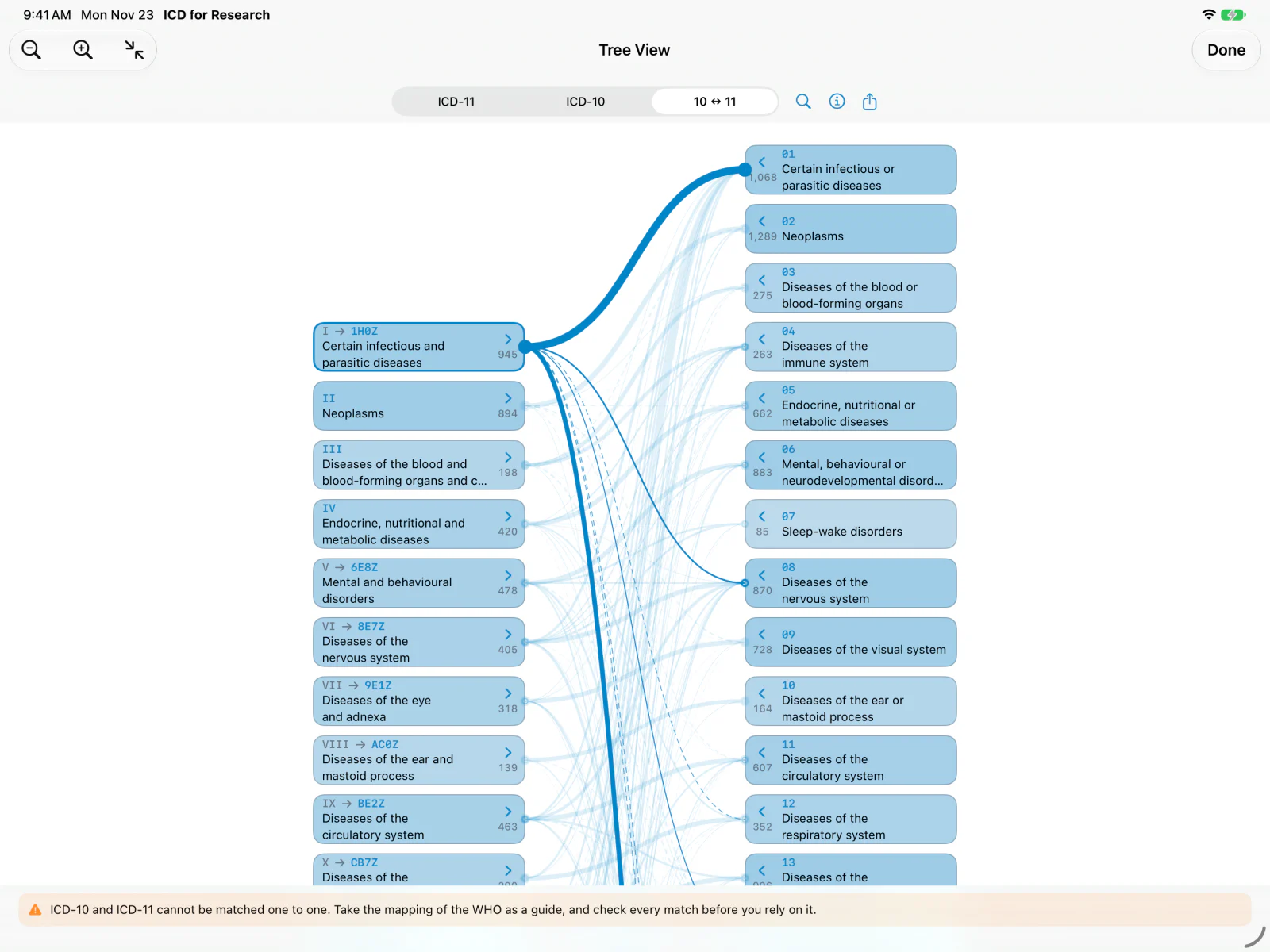
Open a chapter and follow it down to a single category. Every entry says how many stand below it, and the more there are, the stronger its color.
The magnifying glass finds an entry by its code or title and opens the tree down to it. What you see can be shared as a PDF, with the copyright notice of the WHO in place.
ICD-10 ↔ ICD-11
See where a code of ICD-10 went
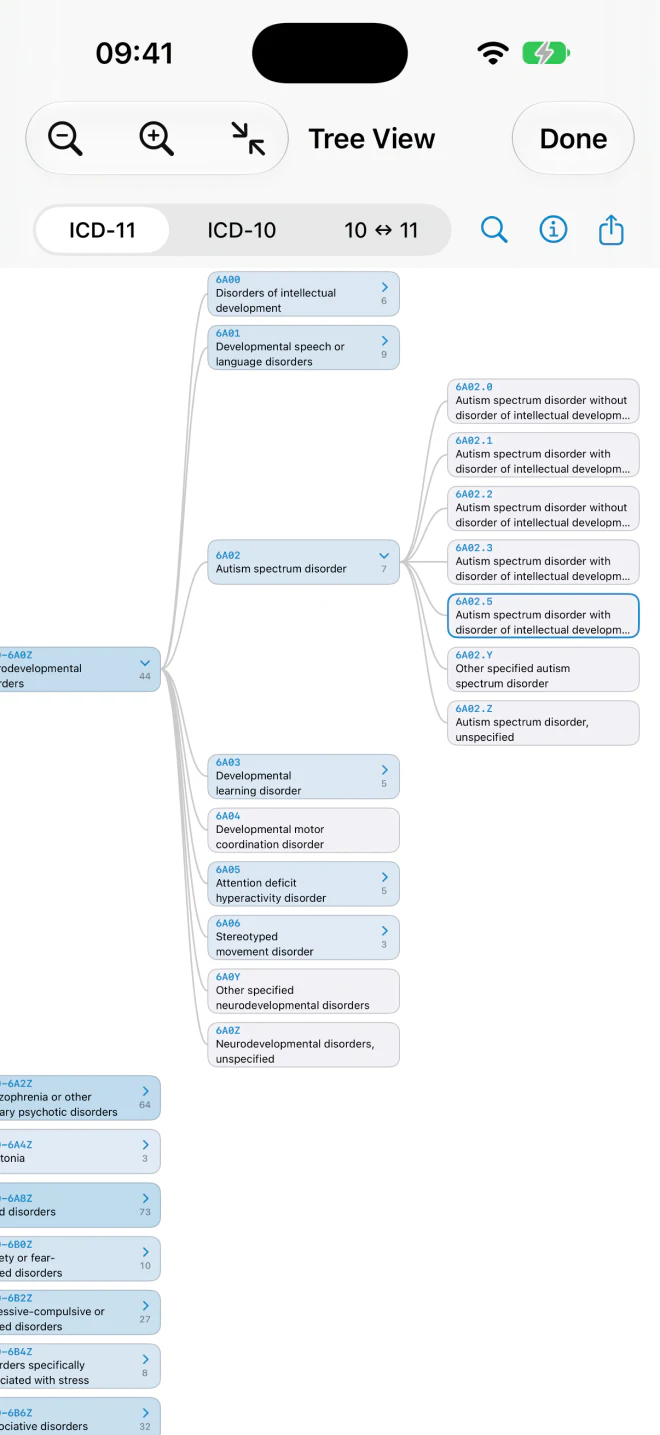
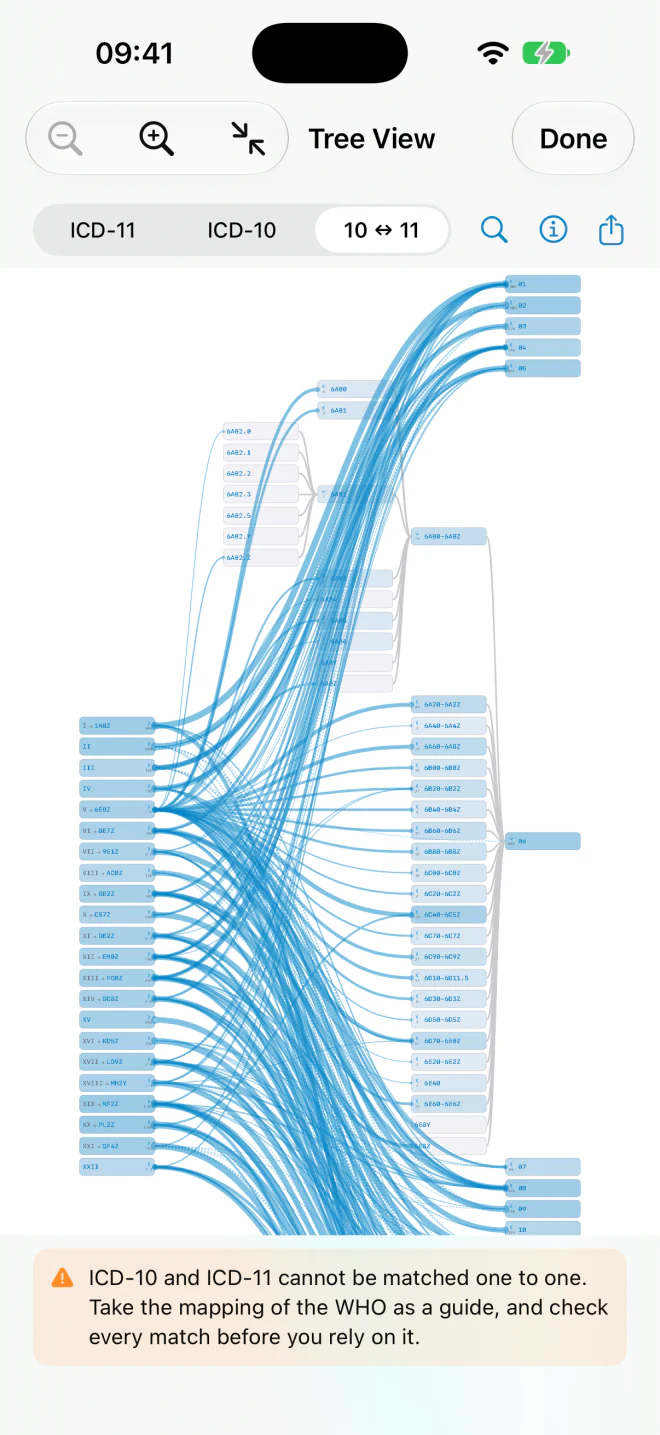
ICD-10 stands on the left, ICD-11 on the right, and a line joins each entry to where the mapping of the WHO finds it. A line is as wide as the codes it stands for are many; dashed lines lead to the further candidates.
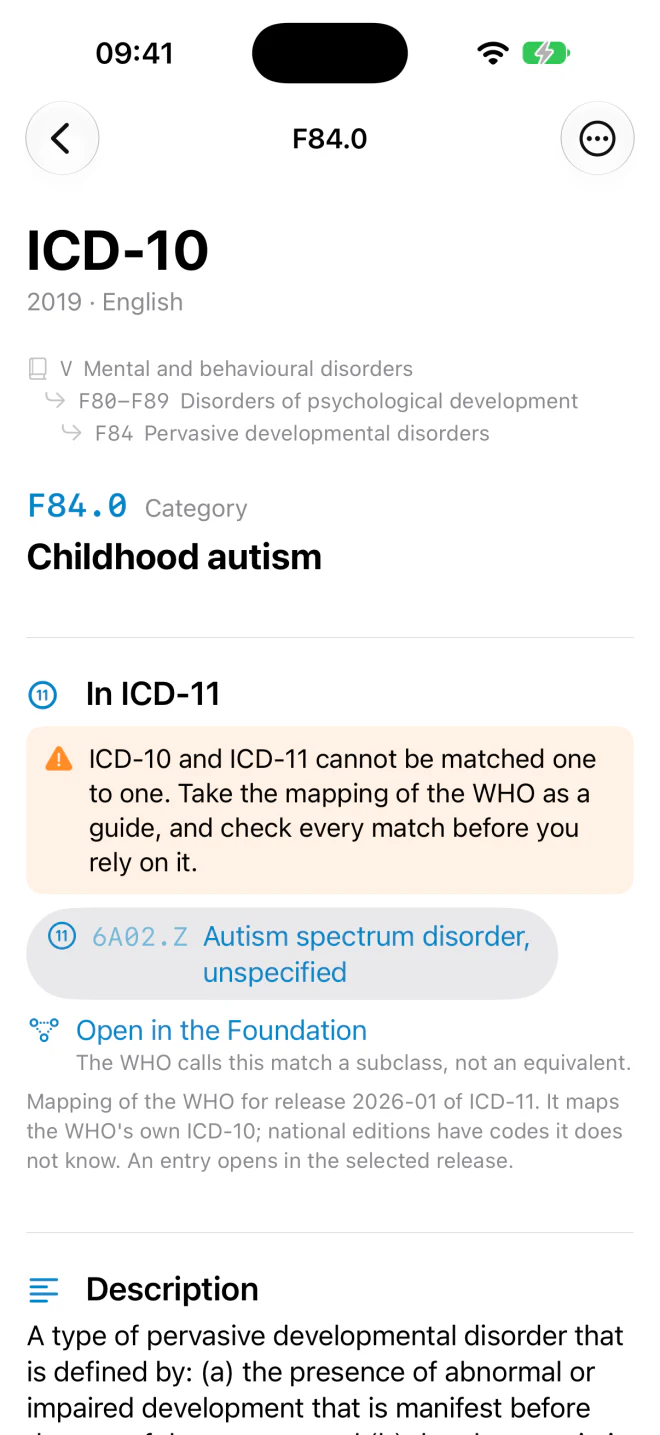
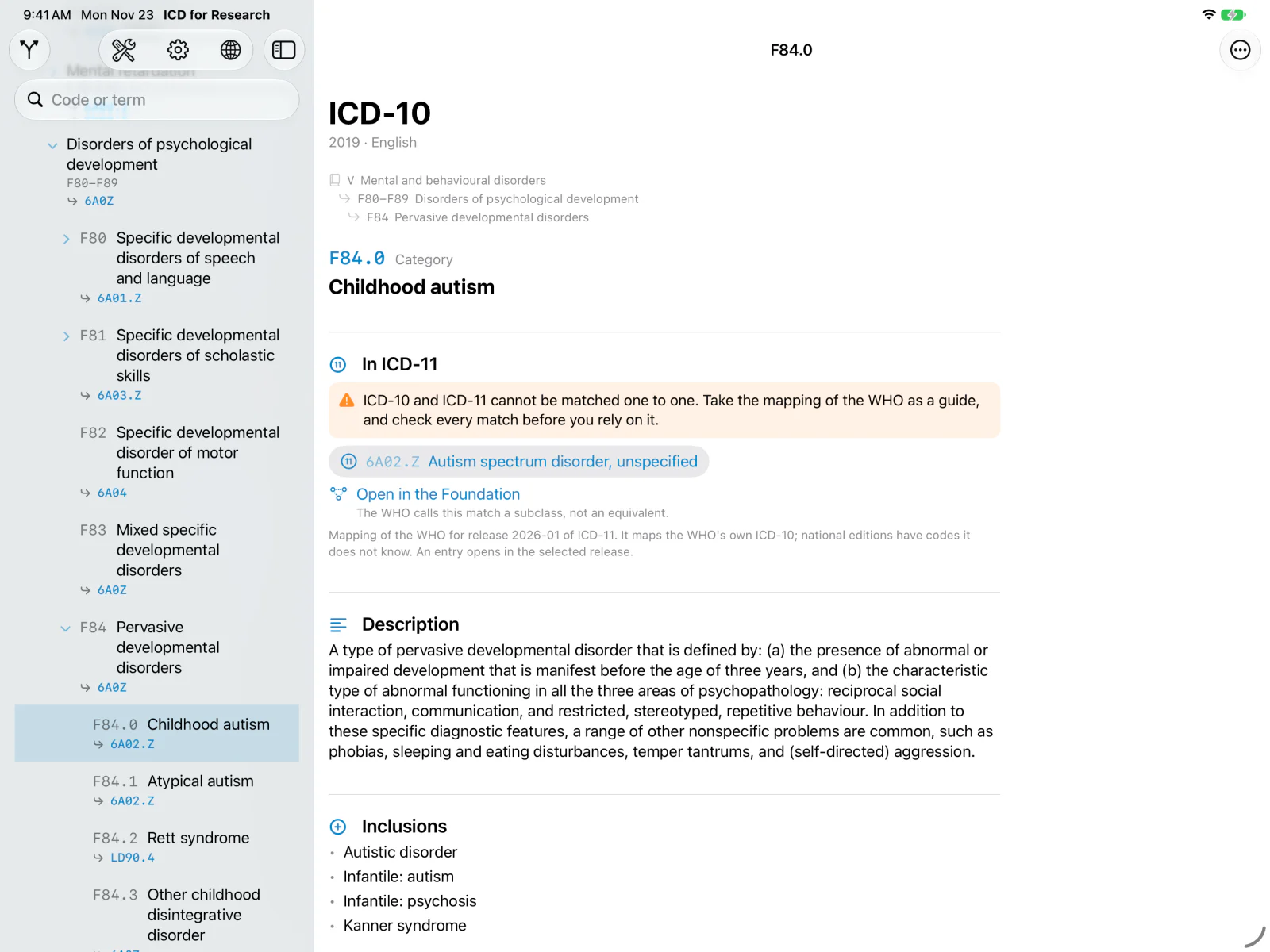
Every entry of ICD-10 names its match, such as F84.0 and 6A02.Z, and says so when the WHO calls it a subclass and not an equivalent. The two revisions cannot be matched one to one, and the app does not pretend they can.
The ICD-10 in the app is the international edition of the WHO, in English. National editions such as ICD-10-GM differ from it.
Releases
What changed between two releases
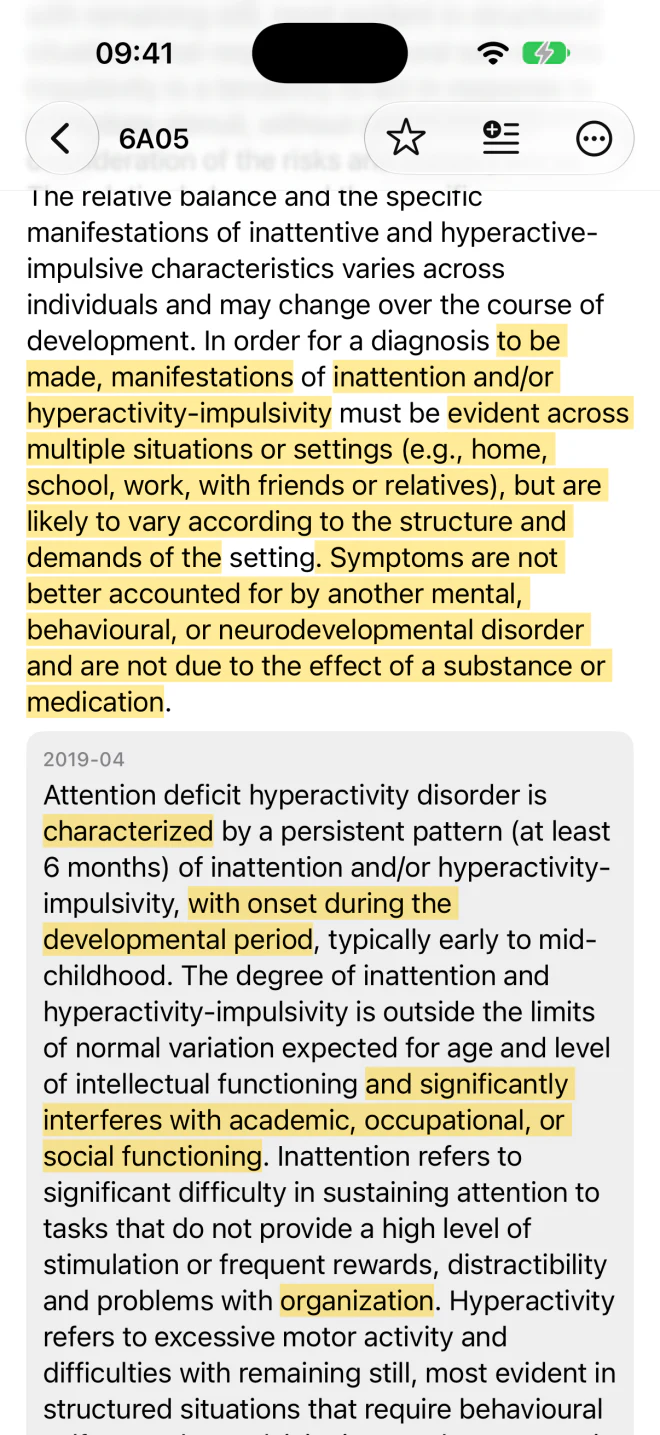
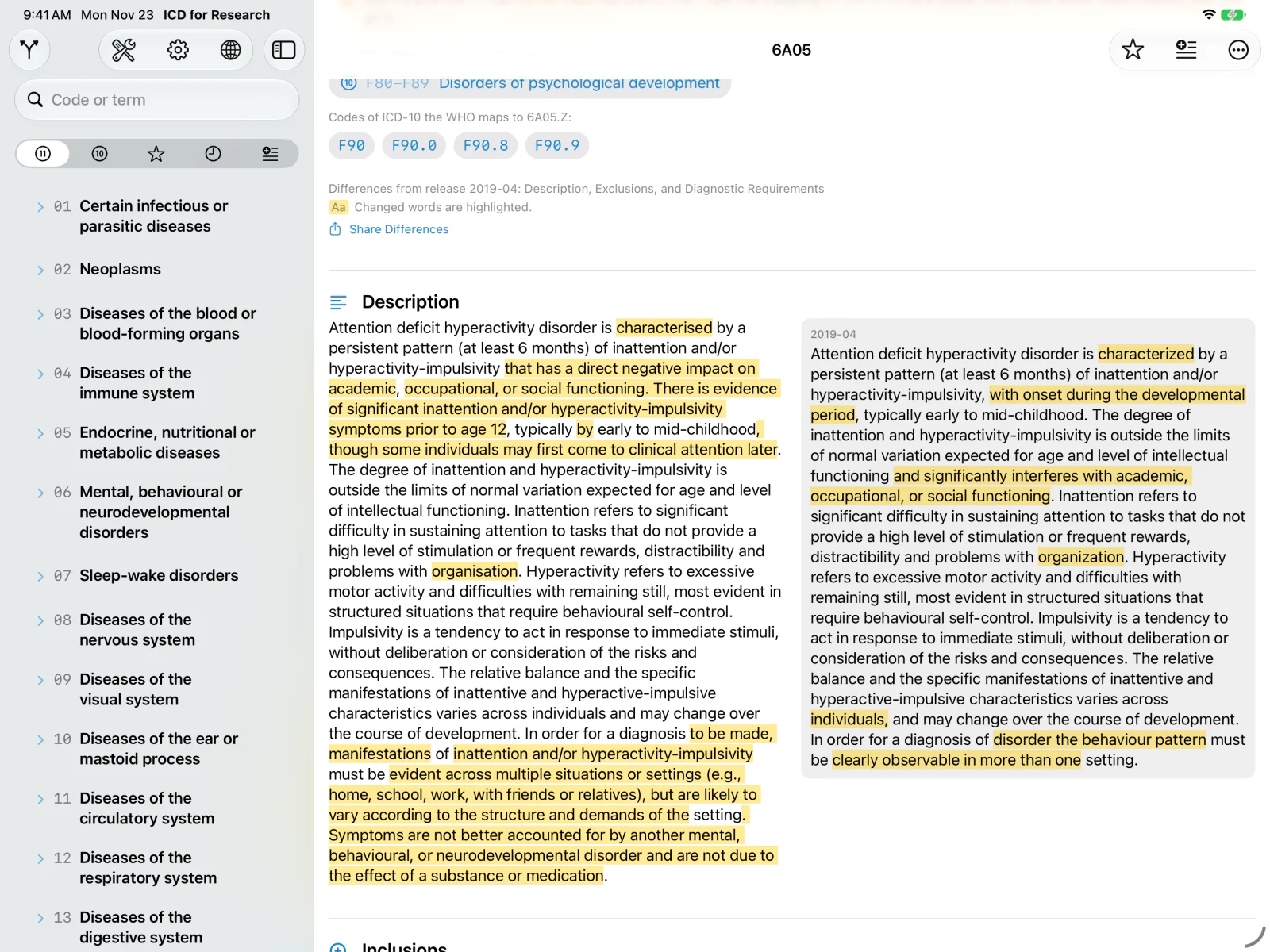
ICD-11 is revised every year. Put an entry in two of its releases side by side, from 2018 to 2026-01, and the changed words are highlighted: in the description, the exclusions, the diagnostic requirements.
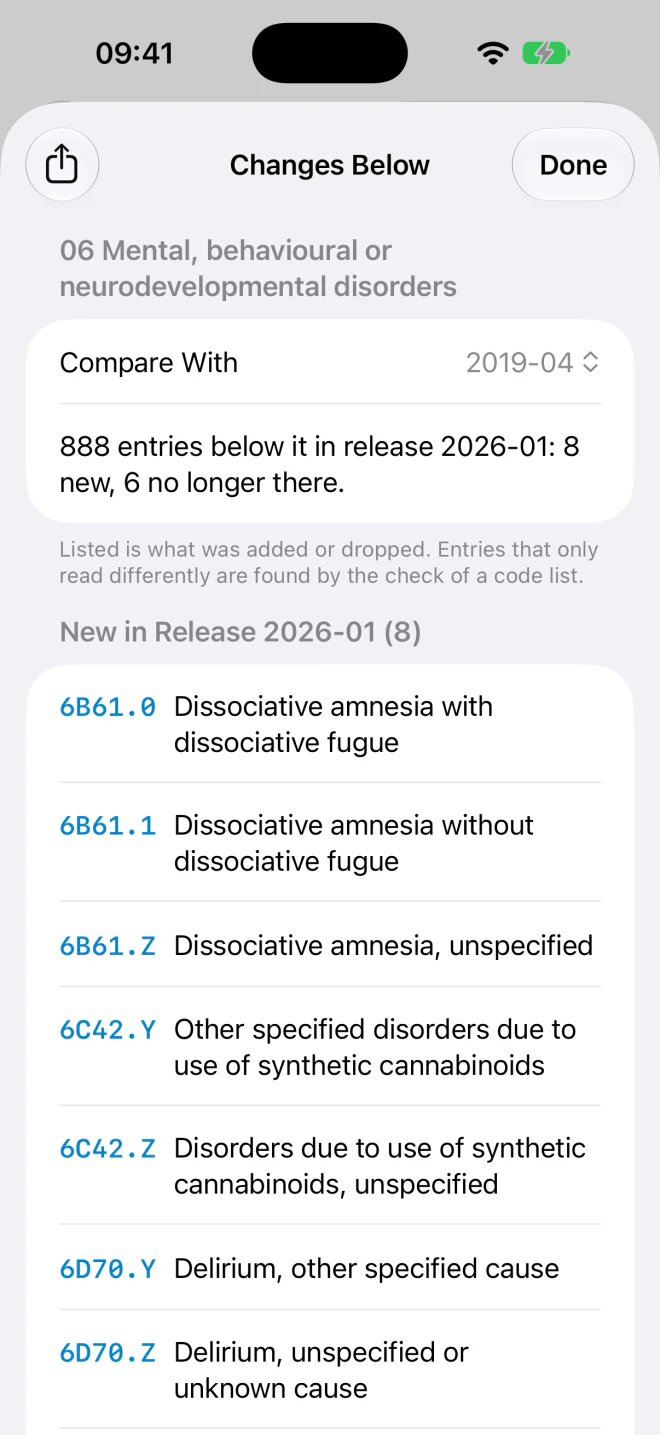
For a chapter or a block, the app lists what was added below it and what is no longer there. The differences can be shared.
Languages
Two languages, side by side
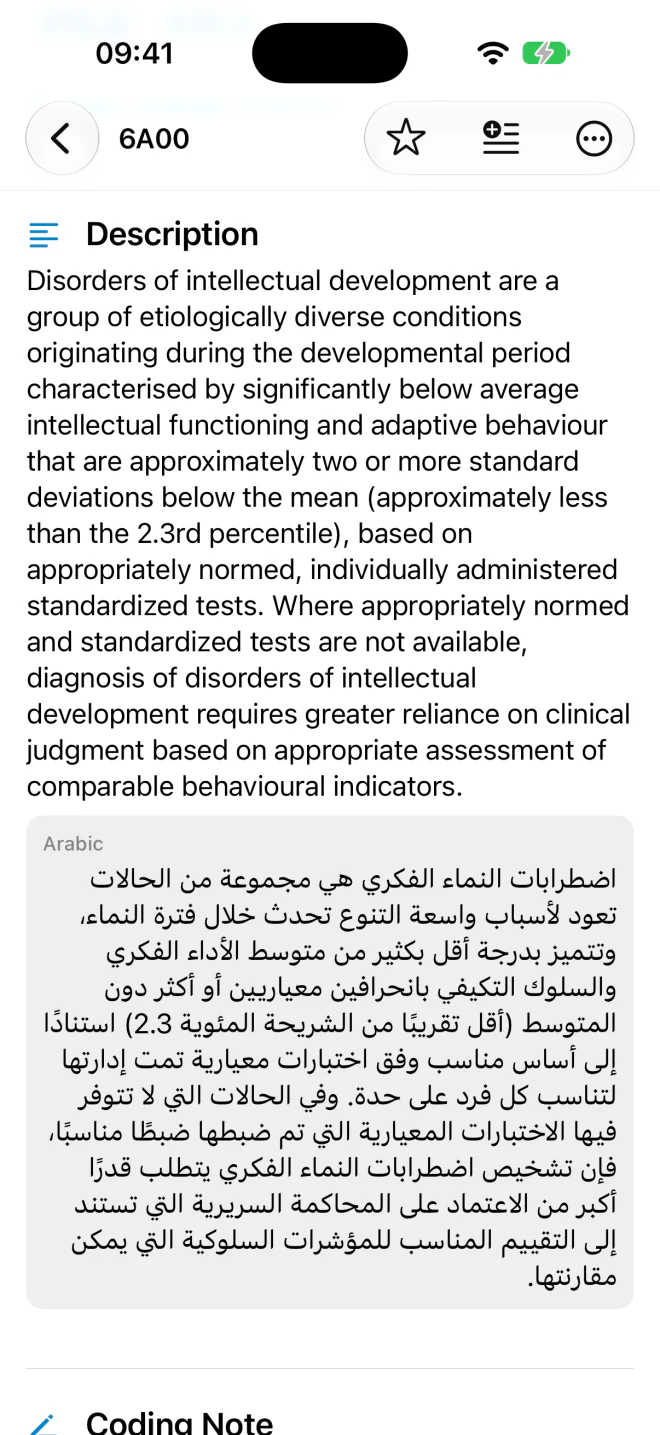
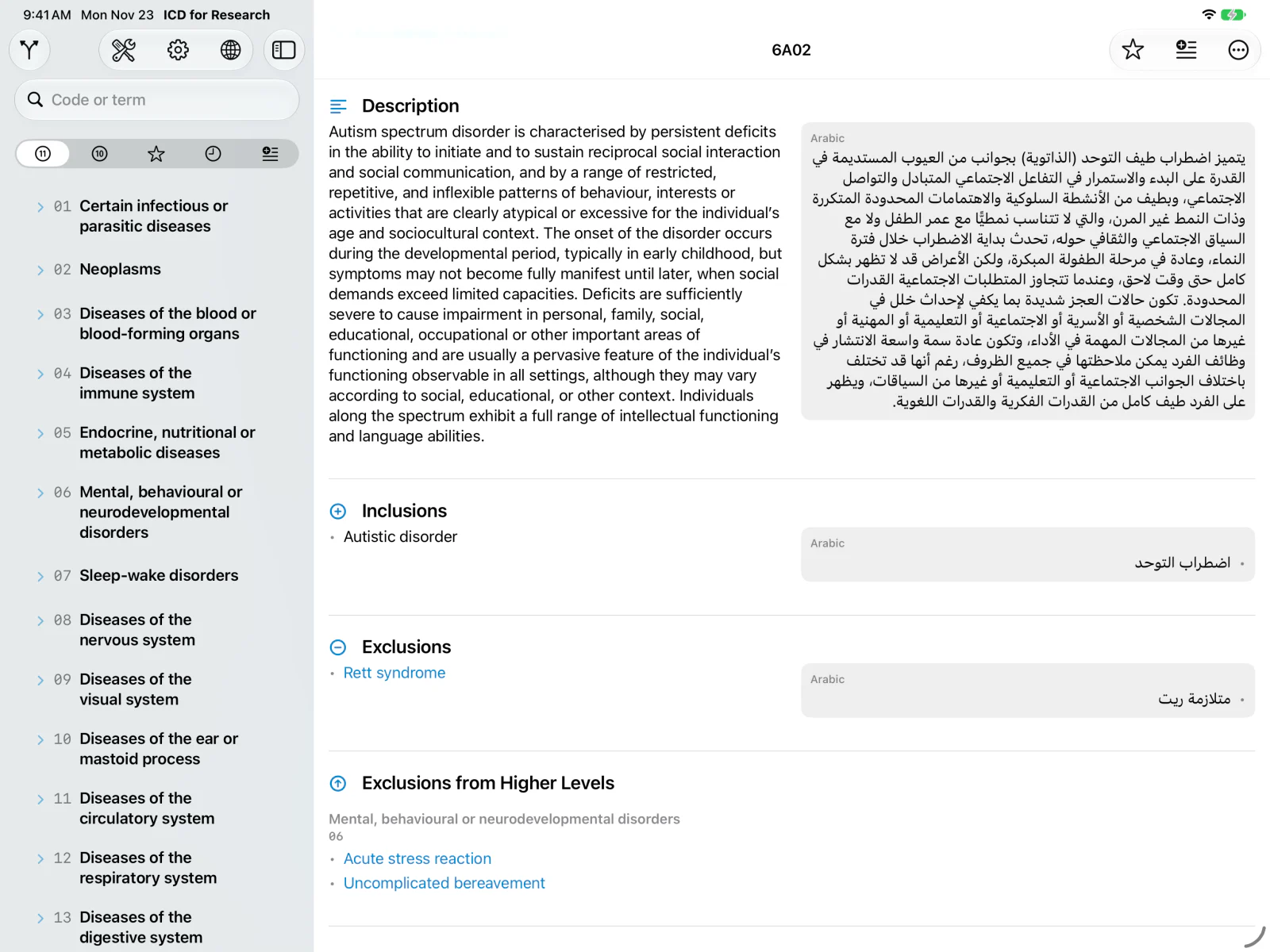
Read an entry in English next to Arabic, Spanish, Chinese, French, Russian or any other language the WHO has translated it into, fifteen in all. Arabic runs from right to left, as it should.
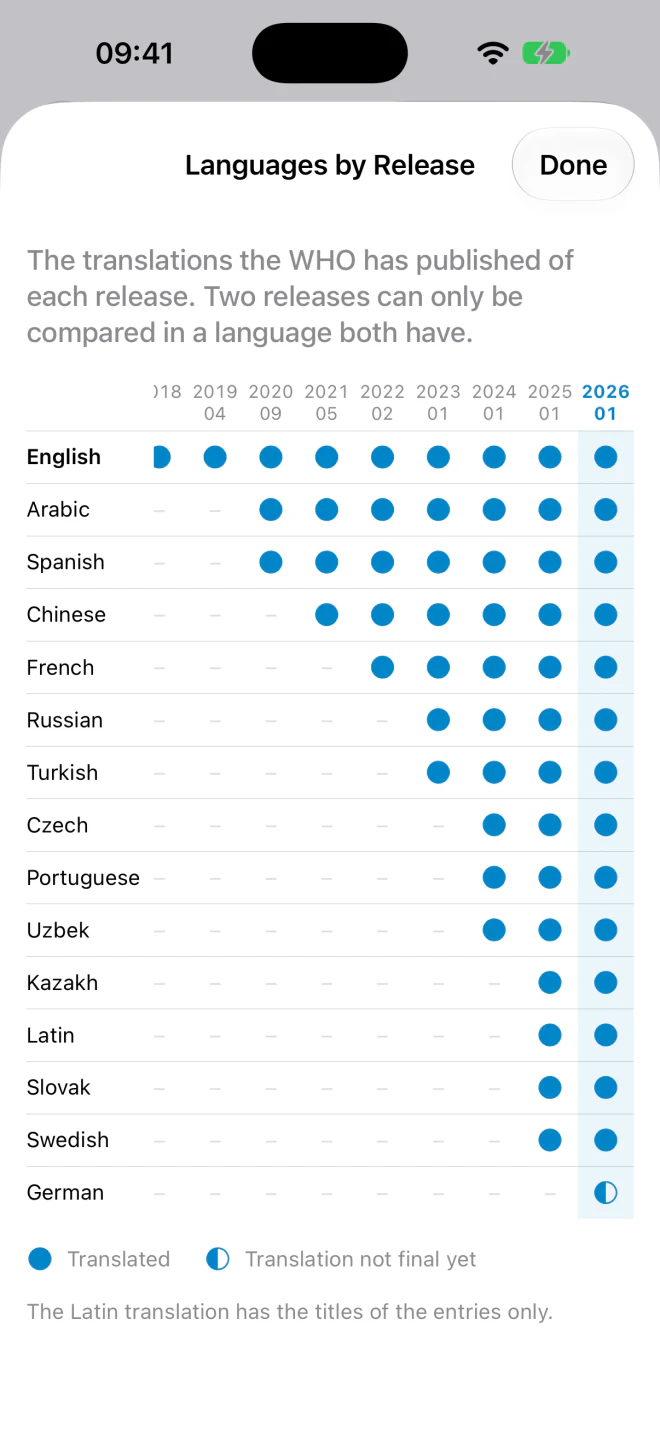
A table shows which translation exists of which release. For a chapter, the app counts the entries whose translation is not complete.
Search
Find it by code or by term
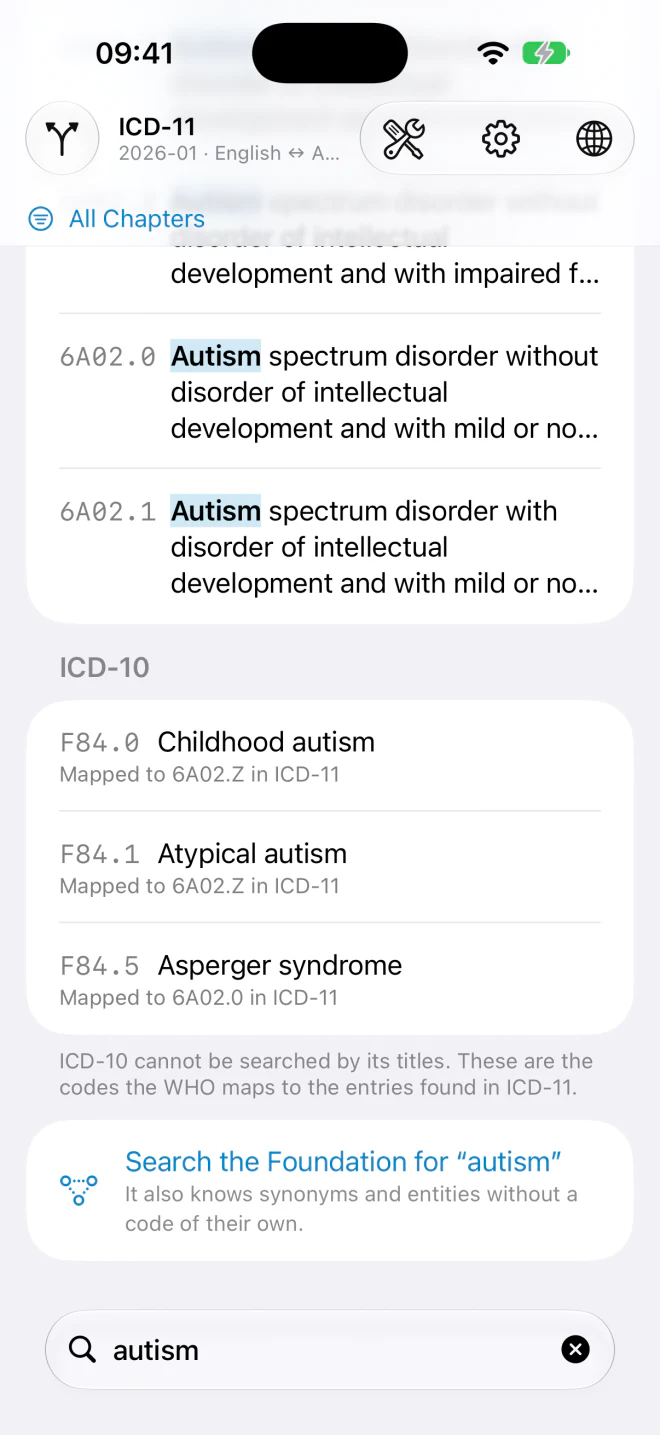
One search finds the entries of ICD-11 and, with them, the codes of ICD-10 the WHO maps to them. It can be kept to a single chapter.
Where the classification has nothing, the Foundation is one tap away. It also knows synonyms and entities without a code of their own, and says under which entry each of them is coded.
Code lists
Keep the codes of a study together
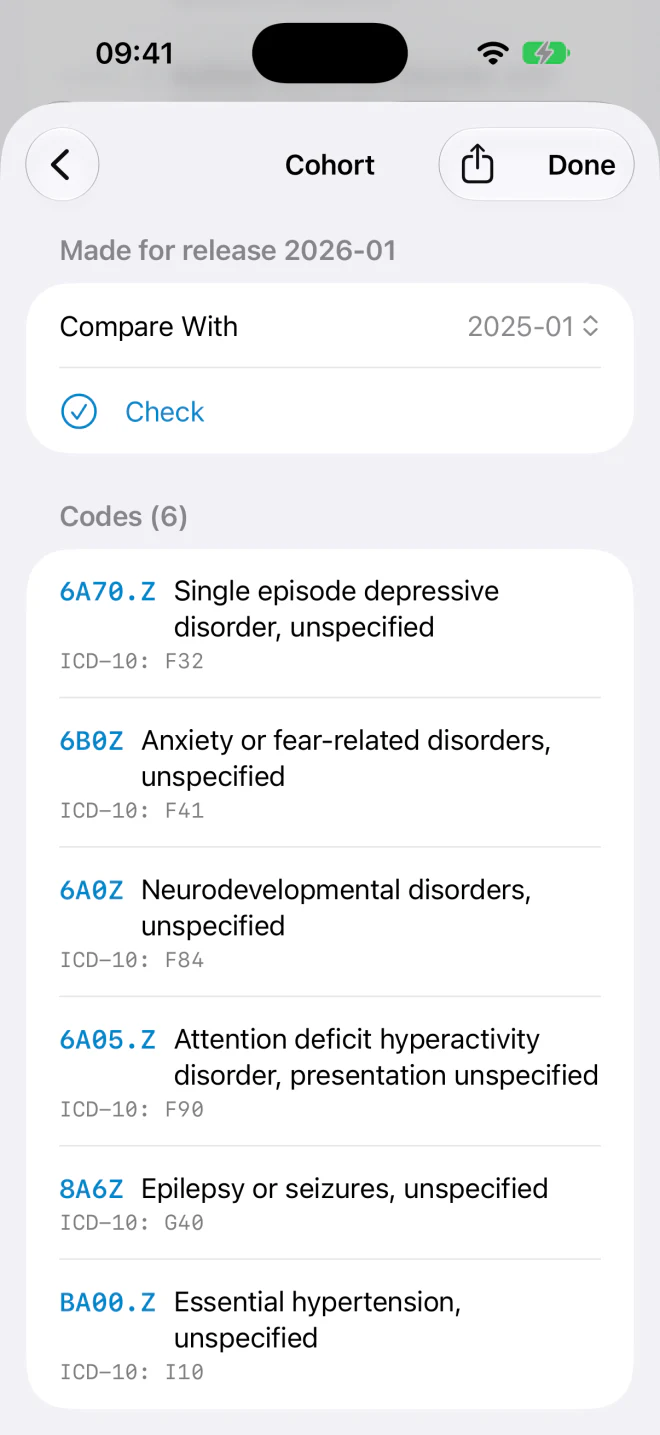
A code list keeps the codes of a study, a register or a course together with the release they were chosen in. Paste codes of ICD-10 as they come, and the list takes the entries of ICD-11 the WHO maps them to.
Check a list against another release to see which of its codes still stand for the same. A list is exported as CSV or PDF.
Clusters
Add detail to a code
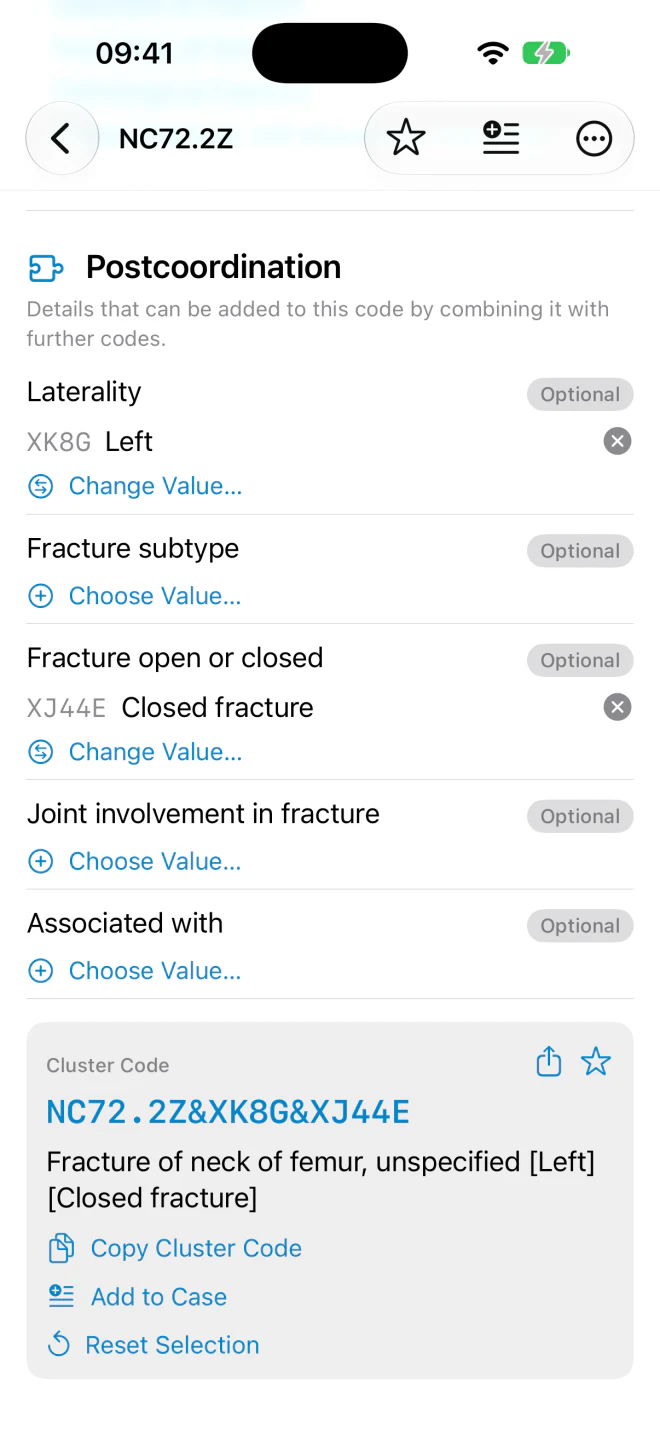
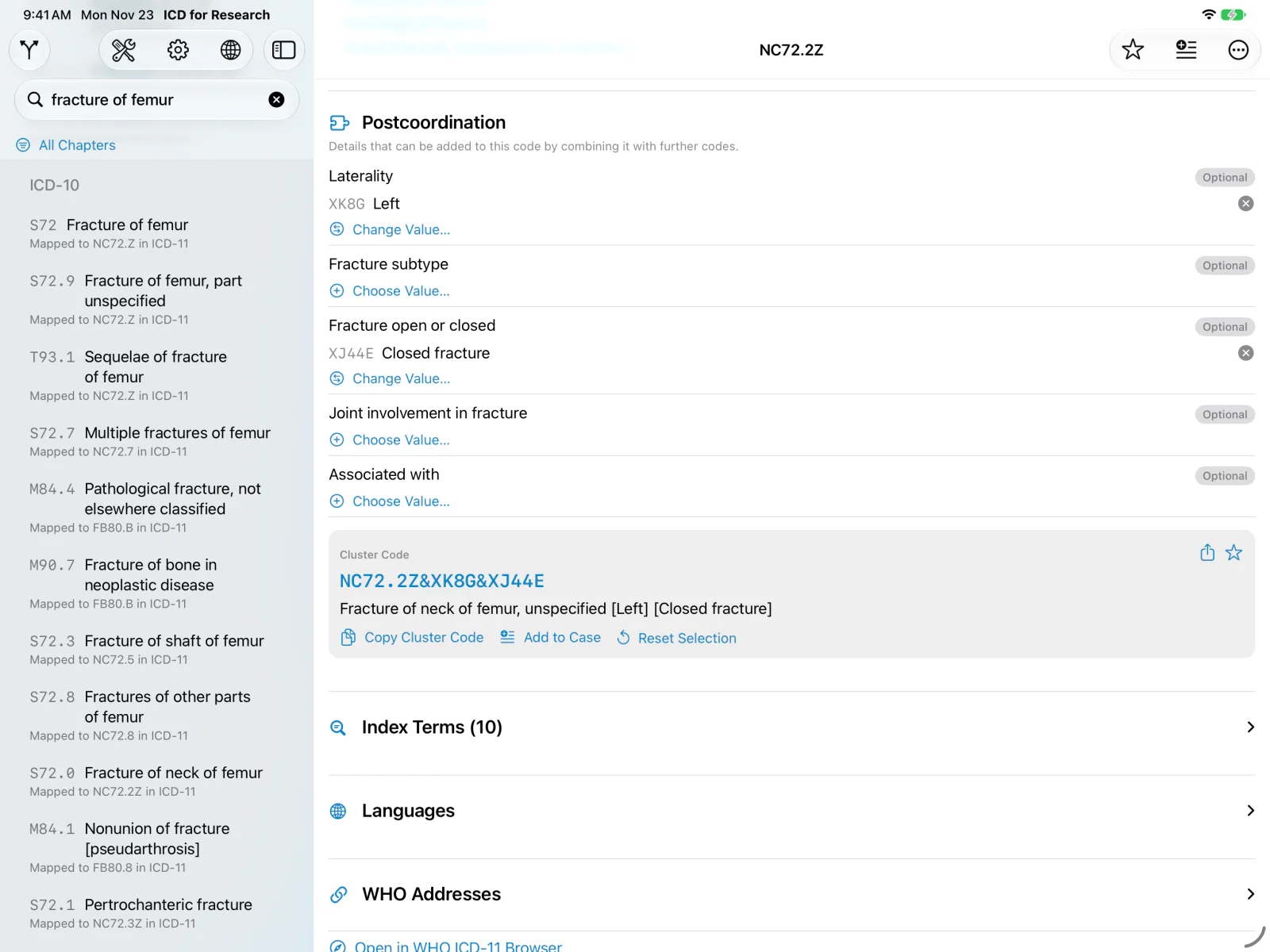
ICD-11 says more by combining codes. For each entry the app shows the details its release allows, such as laterality or the kind of a fracture. Choose the values, and it writes the cluster code: NC72.2Z&XK8G&XJ44E.
Copy the cluster, keep it as a favorite, or add it to a case to copy several codes together.
And
Made for daily work
- Favorites, history, case Kept on your device, and the same on all your devices if you use iCloud.
- A citation for every entry In words or as BibTeX, with the release, the address at the WHO and the date of access.
- Several windows On iPad and Mac an entry opens in a window of its own, next to another.
- Shortcuts An action opens the entry of a code, takes a cluster apart, or searches for a term.
- In fifteen languages The app itself speaks every language the WHO publishes ICD-11 in.
- Accessible Works with VoiceOver, large text, reduced motion and increased contrast.
Privacy
Nothing is collected
The app has no account, no advertising and no analytics, and it sends nothing to its developer. What you look up goes from your device to the WHO and nowhere else.
Favorites, code lists, the history and the case stay on your device. If you are signed in to iCloud they are kept in step through your own iCloud, which the developer cannot read. The access key of the WHO stays in the keychain of each device.
This website sets no cookies, runs no scripts and loads nothing from other servers.
Support
Questions, errors, wishes
Write to web@stiehler.dev. The app is made by Marian Stiehler in Frankfurt am Main.